
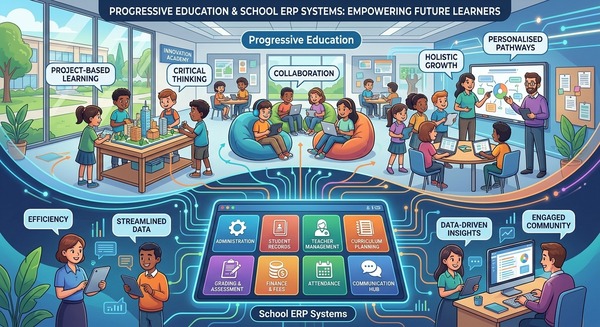
Progressive Education and School ERP Systems: Transforming Modern Learning
Introduction
Education is evolving rapidly in the 21st century. Traditional teaching methods that focus solely on memorization and standardized assessments are giving way to more dynamic, student-centered approaches. One of the most influential educational philosophies driving this change is progressive education. At the same time, schools are increasingly adopting School ERP (Enterprise Resource Planning) systems to streamline administration, improve communication, and support better learning outcomes.
The combination of progressive education and School ERP technology is helping educational institutions create more engaging, efficient, and future-ready learning environments.
Understanding Progressive Education
Progressive education is a teaching philosophy that emphasizes experiential learning, critical thinking, creativity, collaboration, and problem-solving. Instead of focusing exclusively on textbooks and examinations, progressive education encourages students to actively participate in the learning process.
Key Principles of Progressive Education
- Student-centered learning: Students' interests, abilities, and learning styles are considered in lesson planning.
- Experiential learning: Learning through projects, experiments, and real-world experiences.
- Critical thinking: Encouraging students to analyze, evaluate, and solve problems independently.
- Collaboration: Promoting teamwork and communication skills.
- Holistic development: Focusing on emotional, social, physical, and intellectual growth.
This educational approach prepares students not only for academic success but also for the challenges of an increasingly complex and technology-driven world.
The Role of Technology in Progressive Education
Technology has become a critical enabler of progressive education. Digital tools allow educators to personalize learning experiences, track student progress, and facilitate collaboration beyond classroom walls.
Some common technological tools supporting progressive education include:
- Learning Management Systems (LMS)
- Digital classrooms
- Online assessment platforms
- Interactive educational content
- School ERP systems
Among these, School ERP systems play a unique role by connecting academic, administrative, and communication processes into a single platform.
What is a School ERP System?
A School ERP (Enterprise Resource Planning) system is an integrated software solution designed to manage various school operations through a centralized platform.
It automates and simplifies tasks such as:
- Student admissions
- Attendance management
- Examination and grading
- Fee collection
- Timetable scheduling
- Human resource management
- Parent-teacher communication
- Transportation tracking
- Inventory management
By reducing manual paperwork and administrative burdens, School ERP systems allow educators to focus more on teaching and student development.
How School ERP Systems Support Progressive Education
1. Personalized Learning Experiences
Progressive education recognizes that every student learns differently. School ERP systems collect and organize student performance data, enabling teachers to identify individual strengths and areas for improvement.
Benefits include:
- Customized learning plans
- Data-driven interventions
- Better academic support
- Continuous progress monitoring
2. Enhanced Communication and Collaboration
Strong communication among teachers, students, and parents is essential for progressive learning.
ERP systems provide:
- Real-time notifications
- Parent portals
- Teacher-student messaging
- Assignment updates
- Academic performance reports
This transparency helps create a collaborative learning ecosystem.
3. Data-Driven Decision Making
Progressive schools rely on evidence-based strategies to improve educational outcomes.
ERP analytics help administrators:
- Track attendance trends
- Monitor academic performance
- Identify learning gaps
- Measure program effectiveness
- Allocate resources efficiently
Accurate data leads to better planning and decision-making.
4. Efficient Assessment and Feedback
Traditional assessments often provide limited insight into student growth.
School ERP systems support:
- Continuous assessments
- Project-based evaluations
- Performance tracking
- Instant feedback mechanisms
Teachers can monitor learning progress throughout the academic year rather than relying solely on final examinations.
5. Improved Administrative Efficiency
Administrative tasks consume significant time and resources.
ERP automation helps schools:
- Reduce paperwork
- Minimize human errors
- Simplify fee management
- Automate attendance records
- Generate reports instantly
As a result, staff can dedicate more time to educational improvement initiatives.
6. Supporting Hybrid and Digital Learning
Modern education increasingly combines classroom instruction with digital learning experiences.
School ERP platforms facilitate:
- Online class management
- Digital assignment submissions
- Learning resource sharing
- Virtual communication channels
- Remote progress tracking
This flexibility aligns well with the principles of progressive education.
Benefits for Different Stakeholders
For Students
- Personalized learning support
- Better engagement and participation
- Easy access to learning materials
- Continuous feedback and improvement
For Teachers
- Simplified administrative workload
- Better student performance tracking
- Improved classroom management
- Enhanced communication with parents
For Parents
- Real-time updates on attendance and academics
- Easy communication with teachers
- Greater involvement in their child's education
For School Administrators
- Centralized data management
- Improved operational efficiency
- Better compliance and reporting
- Strategic decision-making through analytics
Challenges and Considerations
While School ERP systems offer numerous advantages, schools should consider certain challenges:
- Initial implementation costs
- Staff training requirements
- Data security and privacy concerns
- Resistance to technological change
- System customization needs
Successful implementation requires proper planning, stakeholder involvement, and ongoing support.
The Future of Progressive Education with ERP Technology
The future of education lies in creating personalized, inclusive, and technology-enabled learning experiences. Emerging technologies such as Artificial Intelligence (AI), predictive analytics, and adaptive learning platforms are expected to integrate further with School ERP systems.
Future ERP capabilities may include:
- AI-powered student performance predictions
- Automated learning recommendations
- Smart attendance systems
- Advanced parent engagement tools
- Personalized academic pathways
These innovations will strengthen the connection between progressive educational practices and institutional efficiency.
Conclusion
Progressive education aims to develop well-rounded learners equipped with critical thinking, creativity, and problem-solving skills. To achieve these goals effectively, schools need modern technological support. School ERP systems serve as powerful tools that streamline administration, improve communication, and provide valuable insights into student learning.
By integrating progressive educational principles with robust ERP technology, schools can create a more efficient, transparent, and student-focused learning environment that prepares learners for success in the digital age.