
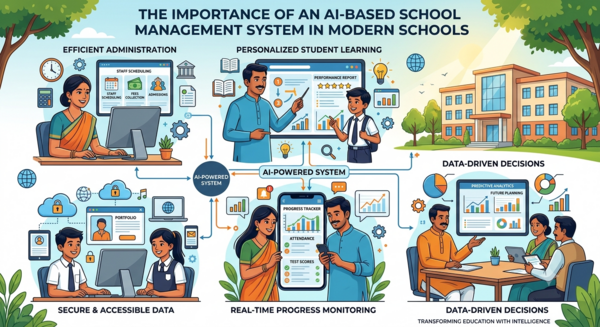
Education is rapidly evolving in the digital age, and schools are increasingly adopting technology to improve administration, teaching, and student outcomes. Among the most transformative innovations is the AI-Based School Management System, which combines artificial intelligence with traditional school management software to automate processes, enhance decision-making, and create a more efficient learning environment.
As schools face growing administrative demands, diverse student needs, and increasing expectations from parents, AI-powered solutions are becoming essential rather than optional. These systems help educational institutions streamline operations, improve communication, and focus more on what truly matters—student success.
What Is an AI-Based School Management System?
An AI-Based School Management System is a digital platform that uses artificial intelligence to manage and optimize various school functions, including:
- Student admissions
- Attendance tracking
- Academic performance monitoring
- Timetable scheduling
- Fee management
- Staff administration
- Parent-teacher communication
- Learning analytics and reporting
By analyzing large volumes of data, AI can identify patterns, generate insights, and automate repetitive tasks, allowing school administrators and educators to work more effectively.
Why AI-Based School Management Systems Are Important
1. Reduces Administrative Workload
School administrators often spend significant time managing paperwork, records, attendance, and scheduling. AI automates these routine tasks, reducing manual effort and minimizing errors.
Benefits:
- Faster data processing
- Reduced paperwork
- Improved operational efficiency
- More time for strategic planning
This enables staff to focus on educational quality rather than administrative burdens.
2. Enhances Student Performance Monitoring
AI systems can track student progress in real time and analyze academic performance across subjects and assessments.
Key advantages include:
- Early identification of learning difficulties
- Personalized performance reports
- Predictive analytics for academic success
- Data-driven intervention strategies
Teachers can provide timely support to students who may be struggling, improving overall learning outcomes.
3. Improves Attendance Management
Traditional attendance methods can be time-consuming and prone to inaccuracies. AI-powered attendance systems can automate the process through facial recognition, biometric integration, or smart tracking technologies.
Benefits include:
- Accurate attendance records
- Real-time notifications to parents
- Reduced proxy attendance
- Better student accountability
Consistent attendance monitoring helps schools identify absenteeism trends early.
4. Facilitates Personalized Learning
Every student learns differently. AI helps schools create personalized learning experiences by analyzing individual strengths, weaknesses, and learning patterns.
AI can:
- Recommend customized learning resources
- Suggest targeted improvement plans
- Adapt educational content to student needs
- Support differentiated instruction
This personalized approach enhances student engagement and academic growth.
5. Strengthens Communication Between Schools and Parents
Effective communication is crucial for student success. AI-based systems provide centralized communication channels that keep parents informed about their child's progress.
Features may include:
- Instant notifications
- Academic performance updates
- Attendance alerts
- Event reminders
- Automated responses to common queries
Improved transparency builds trust and strengthens school-parent relationships.
6. Optimizes Resource Management
Managing classrooms, teachers, transportation, and facilities can be complex. AI helps schools allocate resources more efficiently.
Examples include:
- Smart timetable generation
- Classroom utilization analysis
- Teacher workload balancing
- Transportation route optimization
This ensures maximum productivity while reducing operational costs.
7. Supports Data-Driven Decision Making
Schools generate vast amounts of data every day. AI transforms this information into actionable insights that support informed decision-making.
Administrators can use AI to:
- Forecast enrollment trends
- Analyze academic performance patterns
- Monitor institutional growth
- Evaluate operational efficiency
Better decisions lead to improved educational outcomes and organizational success.
8. Enhances Security and Safety
Student safety is a top priority for every educational institution. AI-powered systems can strengthen campus security through intelligent monitoring and alert mechanisms.
Security features may include:
- Visitor management systems
- Automated emergency alerts
- Access control monitoring
- Suspicious activity detection
These technologies help create a safer environment for students and staff.
9. Improves Financial Management
Managing school finances requires accuracy and transparency. AI simplifies financial operations by automating fee collection, expense tracking, and financial reporting.
Benefits include:
- Automated fee reminders
- Reduced payment delays
- Accurate financial records
- Enhanced budgeting capabilities
This helps schools maintain financial stability and accountability.
10. Prepares Schools for the Future
As educational institutions continue to embrace digital transformation, AI-based management systems position schools for long-term success.
Future-ready schools can:
- Adapt quickly to changing educational demands
- Integrate emerging technologies
- Enhance online and hybrid learning environments
- Deliver better educational experiences
Schools that invest in AI today are better prepared to meet tomorrow's challenges.
Key Benefits at a Glance
Benefit Impact
Automation Reduces manual work and errors Analytics Improves decision-making Personalized Learning Enhances student engagement Communication Strengthens parent-school collaboration Resource Optimization Increases operational efficiency Security Creates safer campuses Financial Management Streamlines fee and budget processes
Challenges and Considerations
While AI offers significant advantages, schools should also consider:
- Data privacy and security requirements
- Initial implementation costs
- Staff training needs
- Ethical use of student data
- System maintenance and updates
Choosing a reliable and secure AI-based solution is essential for maximizing benefits while minimizing risks.
Conclusion
An AI-Based School Management System is transforming the way schools operate by automating administrative tasks, enhancing learning experiences, improving communication, and enabling smarter decision-making. By leveraging artificial intelligence, educational institutions can create more efficient, transparent, and student-focused environments.
As the education sector continues to evolve, AI-powered school management systems will play a crucial role in helping schools improve performance, reduce operational challenges, and prepare students for a technology-driven future. Investing in AI is not just about modernization—it is about creating a smarter, more effective educational ecosystem for everyone involved.